Production-Ready Backend Architecture
On this page
You’ve spent 21 days learning the pieces: routing, auth, validation, caching, errors, scaling, concurrency. Now it’s time to put them together and see what a real production backend actually looks like.
From “It Works” to “It Works in Production”
A backend that works on your laptop and one that survives the real world are two very different things. The difference isn’t more code. It’s architecture: how the pieces are arranged, how they talk to each other, and how they handle things going wrong.
A toy app is one process, one database, no backups, no monitoring. Done in an afternoon.
A production setup answers questions the toy never had to:
- What happens when the database goes down at 3 AM?
- How do you deploy without dropping active requests?
- Where do secrets live?
- How do you know something is slow before users complain?
- What if one part needs 10x more capacity than another?
The Layers of a Production Backend
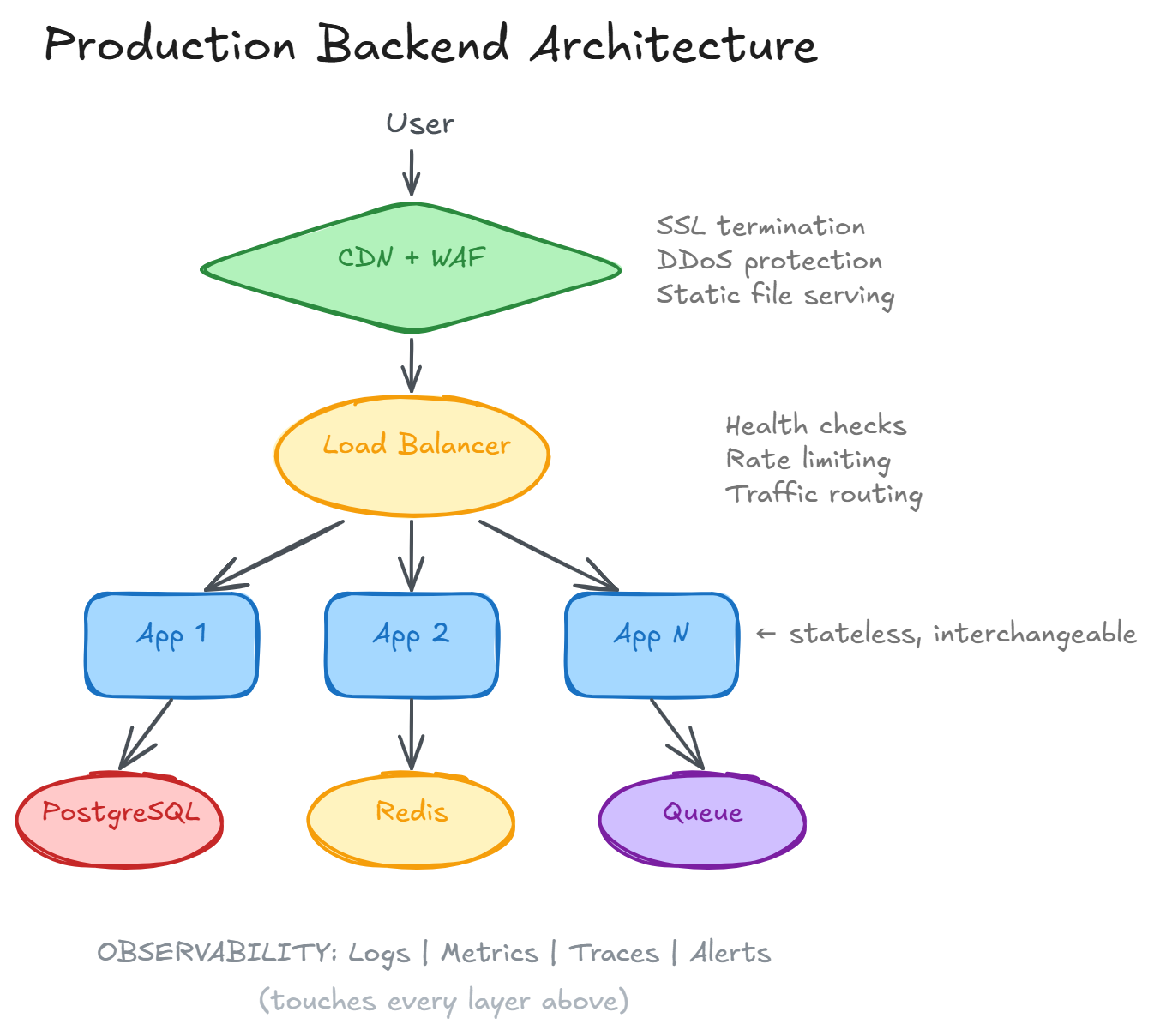
Think of your backend as a stack. Each layer has one job and trusts the layers below it:
Layer 1: Edge / Ingress DNS, CDN (CloudFront, Cloudflare), WAF, and SSL termination. This layer handles traffic before it ever touches your servers.
Layer 2: Load Balancer / Reverse Proxy ALB, Nginx, HAProxy. Spreads traffic across multiple app instances. Does health checks and rate limiting.
Layer 3: Application Layer (stateless) Your actual business logic. Multiple identical instances behind the load balancer. Must be stateless so any instance can serve any request.
Layer 4: Data Layer Databases (PostgreSQL primary + read replicas), caches (Redis), object storage (S3), message queues (SQS).
Layer 5: Observability Logging, metrics, tracing, alerting. Every other layer feeds data here.
The Monolith That Does It Right
Before you break anything into microservices, learn how to build a good monolith first. A messy monolith split into microservices just gives you a messy distributed system.
Modular monolith: one deployable unit, but inside it’s organized into clean modules with clear boundaries.
src/
  users/
    routes.ts
    service.ts
    repository.ts
  orders/
    routes.ts
    service.ts
    repository.ts
  payments/
    routes.ts
    service.ts
    repository.ts
  shared/
    auth.ts
    logger.ts
    errors.ts
Each module owns its own data. Modules talk through clear interfaces, not by digging into each other’s database tables.
When to Go Microservices
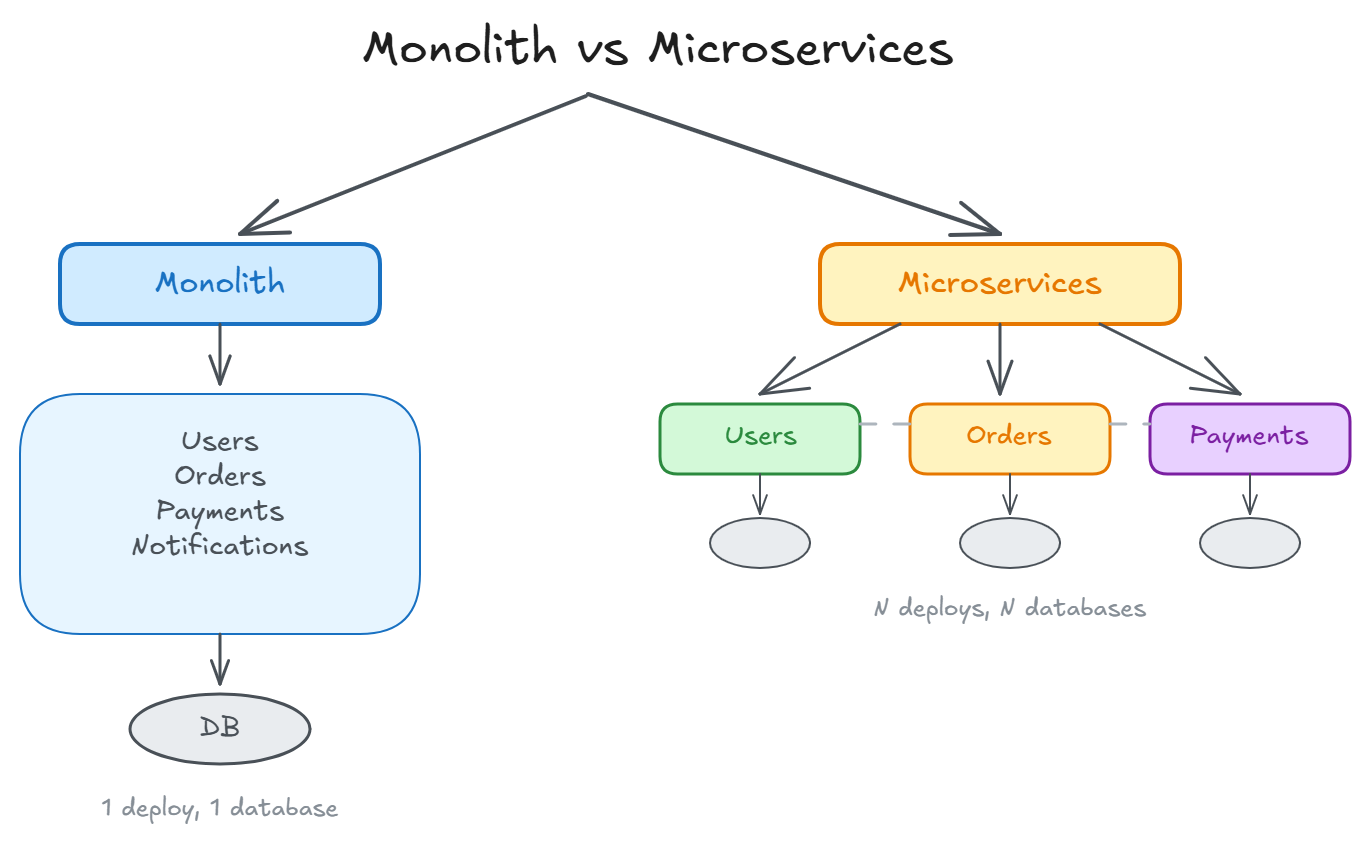
Microservices aren’t “better.” They’re a different set of tradeoffs.
You gain:
- Independent deployment (team A deploys without waiting for team B)
- Independent scaling (search service can have 50 instances while auth has 2)
- Technology freedom
- Fault isolation
You pay:
- Network latency (a local function call becomes an HTTP/gRPC call)
- Distributed data (no more JOINs across domains)
- Operational complexity (10 services means 10 things to deploy and monitor)
- Debugging nightmares (one request might flow through 4 services)
Go microservices when: multiple teams (5+ engineers), very different scaling needs, already hit the limit of a well-structured monolith.
Stay monolith when: small team (1-5 engineers), app isn’t huge yet, no dedicated DevOps support.
The Five Pillars of Production Readiness
1. Reliability
- Retries with exponential backoff
- Circuit breakers
- Timeouts on every external call
- Health checks
- Graceful shutdown
2. Observability
- Structured JSON logging with request IDs
- Metrics: request rate, error rate, p50/p95/p99 latency
- Distributed tracing
- Alerts on error rates and latency thresholds
3. Security
- Secrets in env vars or secret managers
- TLS everywhere
- Least privilege
- Input validation at the boundary
- Rate limiting
4. Scalability
- Stateless application layer
- Database read replicas
- Caching hot data in Redis
- CDN for static assets
- Async work for heavy tasks
5. Operability
- Config via environment
- Database migrations
- Blue-green or rolling deployments
- Feature flags
- Runbooks for known failures
Common Architecture Mistakes
Splitting into microservices too early: breaking a codebase before understanding domain boundaries. You end up with a “distributed monolith”, microservices that all deploy together because they’re tightly coupled.
Shared databases: two services writing to the same table. One database per service, no exceptions.
Synchronous chains: Service A calls B calls C calls D. Each hop adds delay and a failure point. Use async messaging where possible.
Adding observability after things break: Observability is an architecture decision, not an afterthought.
Design Patterns That Actually Matter
- Strategy Pattern: swappable implementations (pay with Stripe vs Razorpay)
- Observer Pattern: event-driven communication. Order placed, email service listens, inventory service listens.
- Decorator Pattern: middleware chains. A raw request gets “decorated” with auth, validation, logging.
Wrapping Up
- Production architecture = layers of responsibility
- Build a clean monolith first, earn microservices through proven boundaries
- Five pillars: reliability, observability, security, scalability, operability
- Microservices solve team scaling but add operational complexity
- Design patterns keep your system flexible as things change
This closes the Backend Foundations chapter. Next: Spring Boot, where we take these concepts and apply them in a real framework.
Day 22 of 95 | Backend Engineering Series